Last updated 08.03.2026
Why isn't saltwater helping my swollen gums anymore?
Learn why saltwater rinses may stop relieving swollen gums, what could be causing the problem and when professional treatment is the right next step.

Saltwater rinses can ease mild gum irritation, but they cannot treat the underlying cause of swelling. If your gums are not improving, are getting worse or keep returning despite rinsing, the underlying cause may need professional care.
What you'll learn in this article:
Saltwater works only on the surface of your gums; it cannot reach the bacteria or infection below the gumline
Swelling that gets worse, keeps returning or does not improve may need professional care
Several conditions (including gum disease, dental abscesses and trapped debris) require care that salt water simply isn't designed to provide
Treatment is usually straightforward once a provider identifies the actual cause
If your gums have been swollen for more than a few days, schedule an appointment with your Aspen Dental provider for a personalized evaluation.
What saltwater can (and cannot) do
Saltwater is a mild antiseptic. It can temporarily reduce bacteria, loosen food particles and soothe irritated gum tissue. For minor inflammation (such as early tenderness, a small cut or irritation from hard food), that may be enough to help.
However, saltwater only works on surfaces it can reach. It can't clean below the gumline, where bacteria often collect. It also can't remove hardened tartar, drain an abscess or eliminate an infection that's already deep in the gum tissue. Once swelling goes beyond mild surface irritation, a saltwater rinse alone won't solve the problem.
Think of it like rinsing a cut that needs stitches. Keeping it clean helps, but it doesn't fix the underlying problem.
Common reasons your gums are still swollen
If your gums are still swollen despite consistent brushing and flossing, one of these underlying causes is likely to blame.
Gum disease has progressed past the early stage
Early gum disease (gingivitis) can often improve with better brushing, flossing and saltwater rinses. But once it progresses to periodontitis, the infection moves below the gumline, where a rinse can't reach it. According to the National Institute of Dental and Craniofacial Research, periodontitis damages the bone and tissues that support your teeth and requires professional treatment to keep it from getting worse.¹
A dental abscess has formed
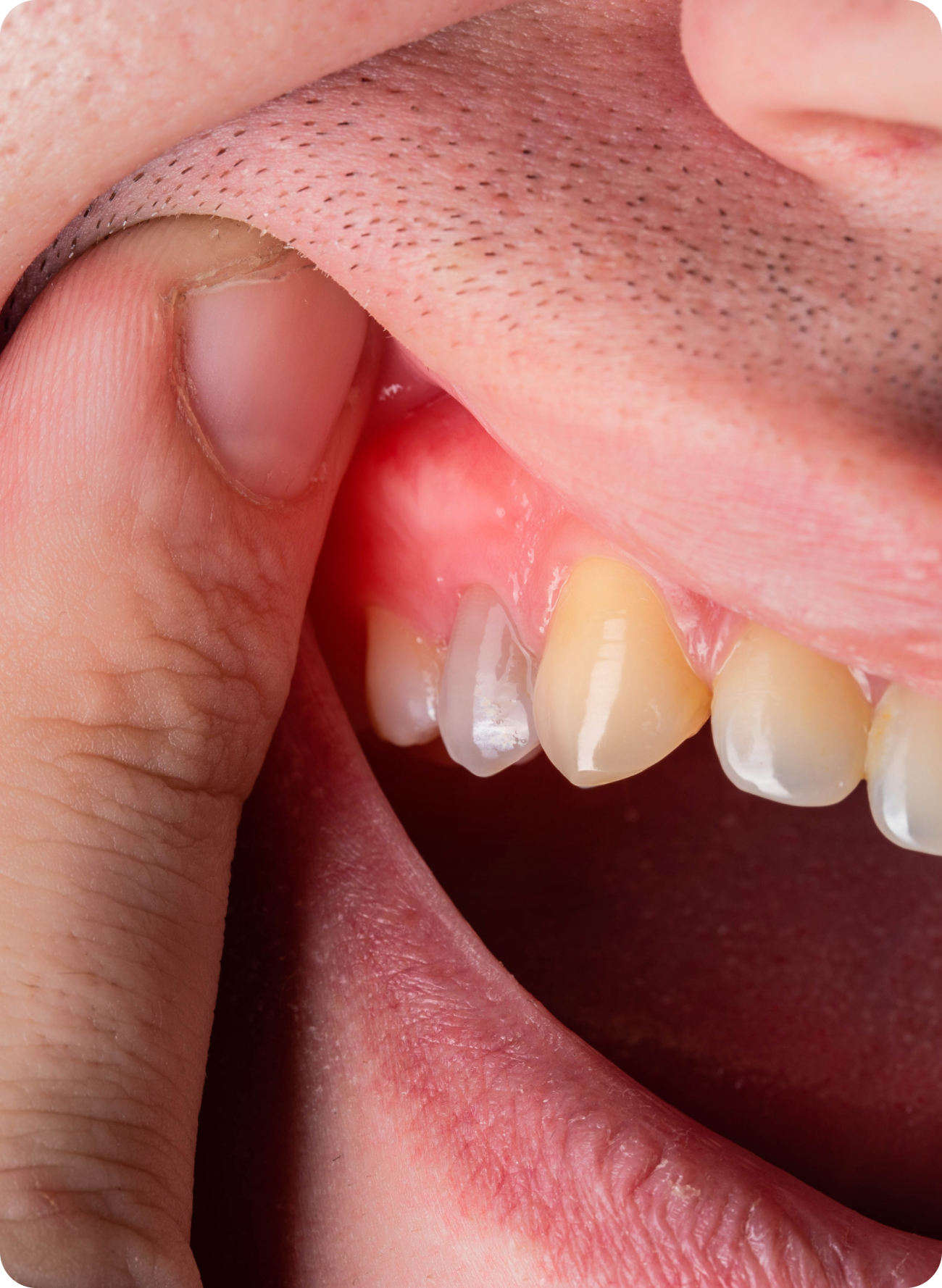
A dental abscess is a pocket of infection around a tooth or inside it. It can cause throbbing, pressure and visible swelling. Salt water may briefly soothe the area, but it cannot treat the infection. An abscess needs professional care, which may include antibiotics, a root canal, drainage or removal of the affected tooth.2
A wisdom tooth or trapped debris is the source
Food particles lodged under the gumline, a partially erupted wisdom tooth or a cracked tooth can all create ongoing irritation that continues as long as the source remains. If the problem is still there, no amount of rinsing will resolve the swelling.
Hormonal changes or medications may be involved
Hormonal changes, vitamin C deficiency and certain medications can all cause or worsen gum swelling.² Pregnancy, puberty and menopause are common hormonal triggers, since shifting hormone levels change blood flow to the gums and make them more prone to swelling. A rinse cannot address any of these.
Signs it's time to stop waiting
Some symptoms mean you should seek care now rather than continuing to manage at home:
Swelling that is getting worse or has lasted more than two weeks
Throbbing or aching that is getting worse instead of better
Swelling spreading toward your jaw or cheek
A visible bump or lump on your gum
Pus or a foul taste coming from the area
Fever
Facial swelling that develops quickly—especially with difficulty breathing or swallowing—requires emergency care, not a routine appointment.
How swollen gums are treated
Most causes of swollen gums are very treatable. Your dental provider will examine the area, take X-rays if needed and determine what's causing the swelling.
Treatment depends on the cause. It may include a professional cleaning to remove bacteria and tartar below the gumline, antibiotics for an infection, treatment for an abscess or care for a problem wisdom tooth. Many people start feeling better within a few days of treatment.
The sooner swollen gums are treated, the easier they usually are to manage. Let your dental provider evaluate the problem before it has a chance to get worse.
Why isn't saltwater helping my swollen gums anymore? FAQs
Here are answers to a few more commonly asked questions people often have about persistent gum swelling.
Can swollen gums affect my overall health?
Yes, they can. Research reviewed by the American Academy of Periodontology has found links between periodontal disease and conditions such as heart disease, diabetes and respiratory disease. These links do not prove that gum disease directly causes those conditions, but inflammation may play a role in some of the associations.³
Can saltwater actually make swollen gums worse?
A standard saltwater rinse—roughly half a teaspoon of salt dissolved in eight ounces of warm water—is safe for most people. However, a solution that is too concentrated or too hot can irritate already sensitive gum tissue. If rinsing seems to be aggravating the area, stop and call your dental provider.
Could my swollen gums eventually heal without treatment?
Mild gum soreness from a minor irritant like a sharp food or temporary trauma often clears up on its own within a day or two. But swelling caused by infection, gum disease or an abscess will not resolve without professional care. If the swelling is getting worse or lasts more than two weeks, contact your dental provider.²
Sources
¹National Institute of Dental and Craniofacial Research. "Periodontal (Gum) Disease." https://www.nidcr.nih.gov/health-info/gum-disease
²Cleveland Clinic. "Swollen Gums: Causes & Treatment." https://my.clevelandclinic.org/health/diseases/24907-swollen-gums
³American Academy of Periodontology. “Gum Disease and Other Diseases.” https://www.perio.org/for-patients/gum-disease-information/gum-disease-and-other-diseases/