Last updated 07.22.2026
Can a dentist tell if you've been vomiting frequently?
Learn how frequent vomiting affects your teeth, the signs your dental provider may notice and how to help protect your enamel from acid damage.

Yes, your dental provider can often recognize the signs of frequent vomiting just by examining your teeth and mouth. Stomach acid is highly corrosive, and repeated exposure leaves a distinctive pattern on your enamel that dental providers are trained to identify.
What you'll learn in this article:
Frequent vomiting erodes enamel in a specific location that sets it apart from erosion caused by acidic foods or drinks.
Several other changes — including swollen glands near the jaw and increased tooth sensitivity — can signal repeated acid exposure.
Frequent vomiting has many causes beyond eating disorders, and your dental provider will approach the conversation without assumptions.
Rinsing immediately after vomiting — not brushing — is the most protective step you can take for your enamel.
If you're concerned about changes to your teeth or oral health, your dental provider can take a closer look at your enamel and tell you exactly what, if anything, needs attention.
What your dental provider can see
Your dental provider looks for a consistent set of changes when they suspect repeated acid exposure. Each sign contributes to the full picture.
Enamel erosion on the inner surfaces of your teeth
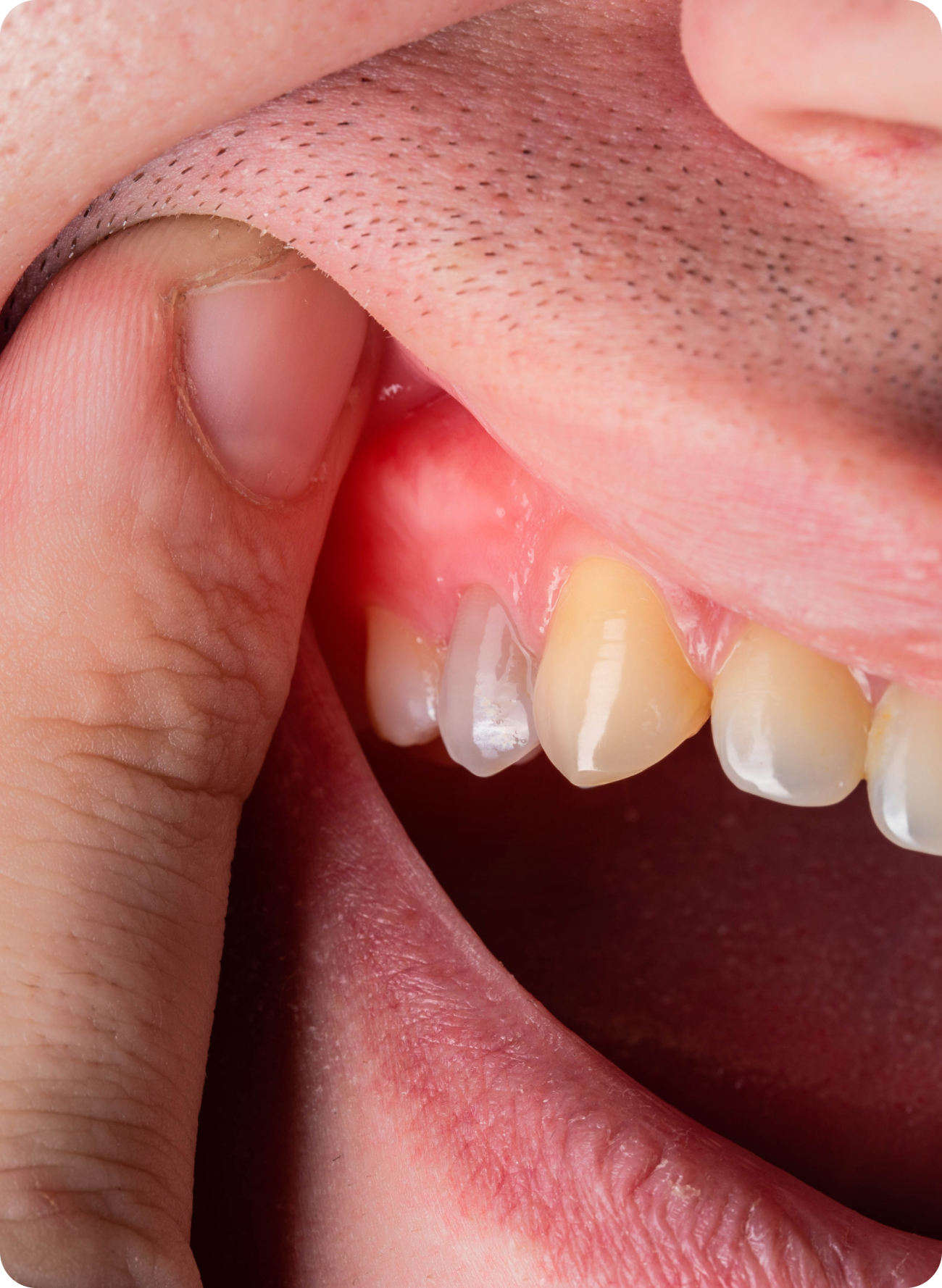
This is one of the clearest signs of damage from stomach acid. The erosion usually starts on the tongue-side surfaces of the upper front teeth because stomach acid flows over those teeth while vomiting.
Over time, the enamel becomes smooth and shiny. The edges of the teeth may look thinner or slightly see-through, and the biting edges may appear flatter. Existing fillings can also seem raised—not because they've changed, but because the surrounding tooth has worn away while the filling stayed the same.1
Swollen glands near your jaw
The parotid glands, located near your jaw and just in front of your ears, can swell in response to repeated vomiting, creating visible puffiness along the jawline.2 These glands produce saliva, which normally helps neutralize acid and protect your enamel. When they're chronically irritated, that protective function is disrupted, leaving your teeth more vulnerable each time acid exposure occurs.
Increased sensitivity and new cavities
As enamel thins, the softer layer beneath it — called dentin — begins to show through, and teeth often become noticeably more sensitive to temperature and sweets. Reduced saliva flow creates an environment where cavity-causing bacteria thrive. Cavities can develop faster than expected, sometimes in locations where you've never had one before.3
Changes inside your mouth
The soft tissue inside your mouth (the roof, the area just behind your upper front teeth and the back of your throat) can develop redness, soreness or small sores from repeated acid contact. Your dental provider examines these areas routinely and may notice subtle changes you haven't detected yourself.
Why your dental provider won't assume a cause
The oral signs of repeated acid exposure don't point to a single diagnosis. People vomit frequently for many reasons:
Gastroesophageal reflux disease (GERD) or chronic acid reflux
Pregnancy-related nausea
Chemotherapy or certain medications
Digestive conditions such as gastroparesis
That's why, if your dental provider sees signs of erosion, they'll ask about your health history, diet and any symptoms you've been experiencing — not to judge your circumstances, but to understand what's driving the problem so they can treat it well.
What treatment might your provider recommend?
Depending on what they find, your provider may recommend:
Prescription fluoride treatments to strengthen remaining enamel
A custom mouth guard to limit further wear
Restorative options — such as bonding or veneers — for teeth with significant damage
A referral to a physician or specialist to address the underlying cause
The earlier these changes are caught, the more treatment options are available to you.
Can a dentist tell if you've been vomiting frequently? FAQs
If you're still wondering what frequent vomiting can do to your teeth or what to expect at your next dental visit, these answers can help.
Should I tell my dental provider I vomit frequently before my appointment?
Yes, and you only need to share what you're comfortable sharing. Letting your dental provider know that you vomit frequently, for any reason, helps them give you the most appropriate care. It shapes which products they recommend, which areas they prioritize and whether a medical referral makes sense. Your provider's focus is your oral health, not the circumstances behind it.
What happens if enamel erosion from stomach acid goes untreated?
Without treatment, enamel erosion keeps getting worse. Teeth become more sensitive to hot, cold, sweets and everyday pressure. As more enamel wears away, the softer dentin underneath becomes exposed. Dentin is more likely to decay, increasing the risk of cavities.
In advanced cases, the tooth can become weak enough to need a crown or other restorative treatment. Treating erosion early helps preserve more of your natural tooth and keeps treatment simpler.
Does mouthwash help after vomiting?
Most standard mouthwashes don't help, and some can make things worse. Alcohol-based mouthwashes reduce saliva flow, which removes one of your mouth's natural defenses against acid. Acidic rinses, including some whitening mouthwashes, can add to the erosion that's already underway.
If you prefer to use mouthwash, choose one that is alcohol-free and fluoride-based — and still wait at least 30 minutes before using it, just as you would before brushing. Plain water or a baking soda rinse remains the most protective and accessible first step.
Sources
1Mayo Clinic. "Bulimia nervosa — Symptoms and causes." https://www.mayoclinic.org/diseases-conditions/bulimia/symptoms-causes/syc-20353615
2National Eating Disorders Association. "Health Consequences of Eating Disorders." https://www.nationaleatingdisorders.org/health-consequences/
3National Institute of Dental and Craniofacial Research. "Tooth Decay." https://www.nidcr.nih.gov/health-info/tooth-decay