Last updated 09.08.2026
What is barodontalgia? Understanding flyer’s toothache
Learn why pressure changes during flying or diving can trigger tooth discomfort and what it may reveal about your oral health.
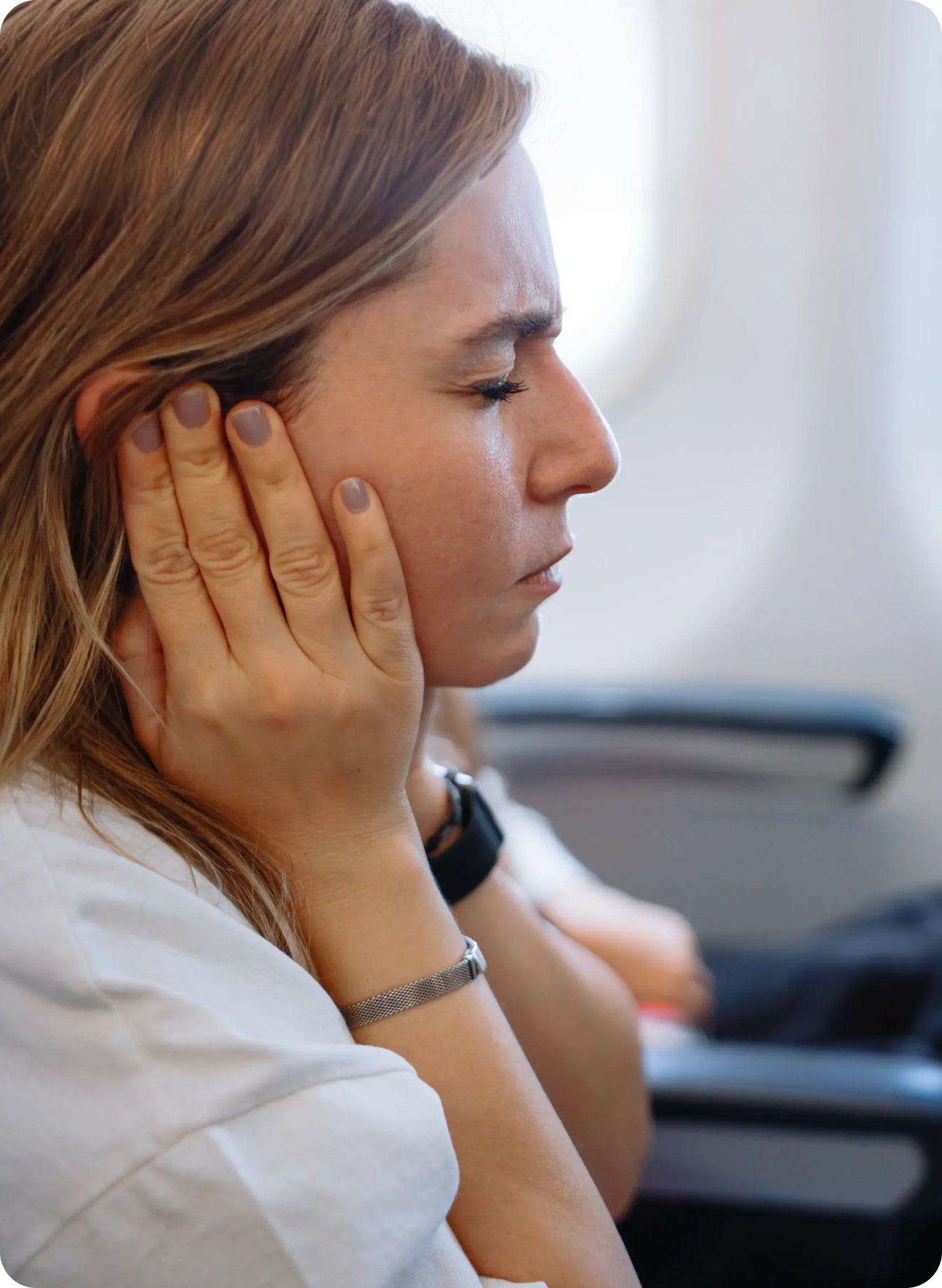
Barodontalgia (pronounced bar-oh-don-TAL-jee-uh) — also called aerodontalgia or flyer's toothache — is tooth discomfort caused by changes in air or water pressure, most commonly during flying or SCUBA diving. It occurs when pressure changes affect a tooth with an underlying problem, such as untreated decay, a crack or inflammation inside the tooth. As pressure shifts, you can experience sudden throbbing, pressure or sharp sensitivity.
Even if the discomfort disappears once the flight ends, it should not be ignored. Barodontalgia is usually a sign that something inside the tooth needs attention. If you experienced tooth discomfort during a flight or dive, schedule an appointment with your Aspen Dental provider to identify the cause before it worsens
What you'll learn in this guide:
Why a tooth that felt completely fine on the ground can suddenly throb at 35,000 feet
How to tell whether the aching is coming from a tooth or your sinuses — and why it matters
Why discomfort during takeoff and discomfort during landing often point to different dental problems
What to do mid-flight to manage the sensation until you can be seen
Which symptoms after landing mean you should not wait to schedule an evaluation
How a routine dental exam before travel can prevent barodontalgia entirely
Why pressure changes cause tooth discomfort
As an aircraft climbs, cabin pressure drops. During descent, it rises again. In a healthy tooth, these pressure changes are harmless because there are no air spaces inside the tooth for pressure to affect.
Barodontalgia develops when a tooth already has an underlying problem, such as decay, a leaking filling, a failing crown or inflammation near the root. These conditions can trap tiny pockets of air or gas inside or around the tooth. As surrounding pressure drops during ascent, trapped gas expands; as pressure rises during descent, it compresses. That expansion and contraction places direct mechanical pressure on the nerve inside the tooth, triggering the throbbing or sharp discomfort flyers describe.
According to a peer-reviewed review published in Case Reports in Dentistry, barodontalgia is almost always a symptom of a pre-existing dental problem rather than a condition on its own.¹
What dental conditions make a tooth vulnerable to pressure changes?
Any condition that compromises the sealed structure of a tooth can create the air pockets responsible for barodontalgia:
Untreated cavities: Decay creates hollow spaces within enamel where air collects.
Aging or failing restorations: Older fillings or crowns can develop micro-leaks where the seal between the restoration and the tooth has weakened over time.
Dental abscesses: An infection at the root can produce gas or trap air that reacts to pressure shifts.
Teeth undergoing or recently completing root canal treatment: A tooth in active treatment or with a temporary restoration may not be fully sealed.
Cracked teeth: Even a hairline crack invisible to the naked eye can allow air to enter the tooth structure.
Takeoff versus landing — why the timing of your discomfort matters
The moment your tooth starts aching during a flight is clinically meaningful. Your dentist will likely ask about this during your evaluation.
Why does my tooth ache during takeoff?
Discomfort that begins during ascent — as the plane climbs and cabin pressure drops — is typically caused by trapped air expanding inside the tooth. This pattern is most commonly associated with pulpitis (inflammation of the tooth's nerve), an active inflammation, an abscess or a compromised restoration. The expanding air pushes outward against the nerve, producing a sharp or throbbing sensation that may ease once the plane reaches cruising altitude and pressure stabilizes.
Why does my tooth ache during landing?
Discomfort that begins during descent — as cabin pressure increases — tends to follow a different pattern. Contracting air or a mild vacuum effect inside the tooth can pull on the nerve rather than push against it. This pattern is also associated with maxillary sinus pressure, which can refer aching into the upper back teeth as the sinuses respond to increasing pressure.
How can I tell if it is a toothache or a sinus issue?
This is one of the most common points of confusion with barodontalgia. A few distinctions can help:
Sinus-related aching tends to affect several upper back teeth simultaneously, feels dull and heavy rather than sharp and is often accompanied by nasal congestion or a feeling of facial fullness.
Tooth-related barodontalgia is typically localized to one specific tooth, feels sharp or throbbing and may be more intense than general sinus pressure.
If you are unsure, an evaluation at your dentist’s office — including X-rays — can identify the source.
Managing the discomfort mid-flight
There is no way to fully resolve barodontalgia while in the air since the underlying dental issue requires professional treatment. However, a few steps can reduce the intensity of the sensation:
Avoid temperature extremes: Hot coffee or ice-cold drinks can worsen nerve sensitivity during pressure changes — stick to room-temperature water.
Do not chew on the affected side: Chewing increases pressure on the tooth and can intensify the aching.
Use an over-the-counter analgesic if needed: Ibuprofen or acetaminophen taken before boarding can reduce inflammation and blunt the sensation — follow package directions.
Equalize pressure gently: Swallowing, yawning or chewing gum during ascent and descent helps equalize pressure in the ears and sinuses, which may reduce referred aching in the upper teeth.
These steps manage the symptom. They do not address the underlying cause.
When to see your dentist
If your tooth ached during a flight but the discomfort resolved completely once you landed, you still need an evaluation — the episode is a sign that a dental issue may be present. Barodontalgia does not typically occur in healthy, intact teeth.
Schedule an appointment promptly if:
The throbbing or aching persisted for more than a few hours after landing.
The discomfort was severe enough to be distracting during the flight.
You noticed sensitivity to temperature or pressure in the same tooth before or after the flight.
You have an older filling, crown or recent dental work on the affected tooth.
The episode has happened on more than one flight.
Do not wait for the next flight to confirm the problem. The underlying condition — whether a cavity, a failing restoration or an infection — will not resolve on its own and is likely to worsen with time.
If you are a frequent flyer or diver, a comprehensive dental exam before your next trip is an effective way to prevent barodontalgia from occurring. Your dentist can identify and address any compromised teeth before pressure changes have the chance to reveal them at altitude.
How barodontalgia is treated
Treatment is directed entirely at the underlying dental condition — not at the pressure sensitivity itself. Once the source is addressed, barodontalgia typically resolves.
Depending on what your dental provider finds, treatment may include:
Filling or replacing a restoration: If a cavity or a micro-leaking filling is the source, restoring the tooth is necessary
Crown replacement: A failing crown with a compromised seal can be replaced to fully re-seal the tooth
Root canal treatment: If the nerve is inflamed (pulpitis) or an abscess is present, root canal treatment removes the affected tissue and seals the tooth
Extraction (in rare cases): If a tooth is too compromised to restore, removal is usually recommended
In many cases, treating the underlying condition can resolve barodontalgia. The key is identifying the specific tooth and condition causing the reaction.
Don't let an undetected dental issue ground your plans. If you've noticed tooth discomfort during a recent flight or dive — or you have one coming up — that's your signal to get checked before you go. A dentist can identify any underlying conditions and treat them before pressure changes turn a minor issue into a painful one at altitude. Schedule an appointment at your nearest dentist’s office and fly (or dive) with confidence.
Barodontalgia (Flyer’s Toothache) FAQs
Can barodontalgia happen during SCUBA diving?
Yes. Divers experience the same pressure dynamics as flyers — pressure decreases as you ascend toward the surface and increases as you descend. The condition is sometimes called "tooth squeeze" in diving contexts. The underlying causes and treatment are identical to flight-related barodontalgia.
Is barodontalgia a dental emergency?
Discomfort that resolves within a few hours of landing is not typically an emergency, but it does require a prompt evaluation. Discomfort that persists beyond several hours after landing, is accompanied by visible swelling or fever or is severe enough to be debilitating should be evaluated as soon as possible — these signs may indicate an active abscess.
Can a brand-new filling cause barodontalgia?
Yes, in some cases. A tooth that has recently been filled may still have some residual inflammation in the nerve tissue (reversible pulpitis). This inflammation can make the tooth temporarily sensitive to pressure changes. If you have had recent dental work and experienced barodontalgia on a subsequent flight, let your dentist know — they can assess whether the nerve has settled or whether additional treatment is needed.
How long does barodontalgia last?
In most cases, the discomfort subsides within minutes to a few hours once the aircraft reaches a stable altitude or after landing when pressure normalizes. If the aching persists beyond 4–6 hours after your flight, the underlying dental condition may have been aggravated by the pressure change and warrants same-day or next-day evaluation.
Can I prevent barodontalgia before a long trip?
Yes. A comprehensive dental exam 2–4 weeks before a long-haul flight or diving trip gives your dentist time to identify and treat any compromised teeth before travel. Patients with known cavities, older restorations or recent dental work are at the highest risk and benefit most from a pre-travel evaluation.
Source
¹ Stoetzer M, et al. Pathophysiology of Barodontalgia: A Case Report and Review of the Literature. Case Reports in Dentistry, 2012. https://pmc.ncbi.nlm.nih.gov/articles/PMC3518957/