Last updated 07.13.2026
Why is the roof of my mouth sore after a tooth extraction?
Learn why the roof of your mouth may hurt after a tooth extraction, what's considered normal healing and when soreness could signal a problem.

Soreness on the roof of your mouth after a tooth extraction is a normal reaction. In most cases, what you're feeling comes from the numbing injection placed directly on the palate during your procedure, not from the extraction socket itself.
What you'll learn in this article:
The numbing injection in the roof of your mouth is the most common reason it feels sore after an upper tooth extraction.
Roof-of-mouth soreness usually gets better within 5–7 days, with the most discomfort during the first 1–2 days.
Pain that gets worse after day 3, or comes with a bad taste, fever or white patches, should be checked by your dental provider.
Warm saltwater rinses, soft foods and avoiding hot foods and drinks can help the area heal.
Because the soreness is often caused by the injection rather than the extraction itself, it can catch people off guard. Knowing what's normal—and when it isn't—can help you heal with confidence and know when it's time to contact your dental provider.
What's actually causing the soreness
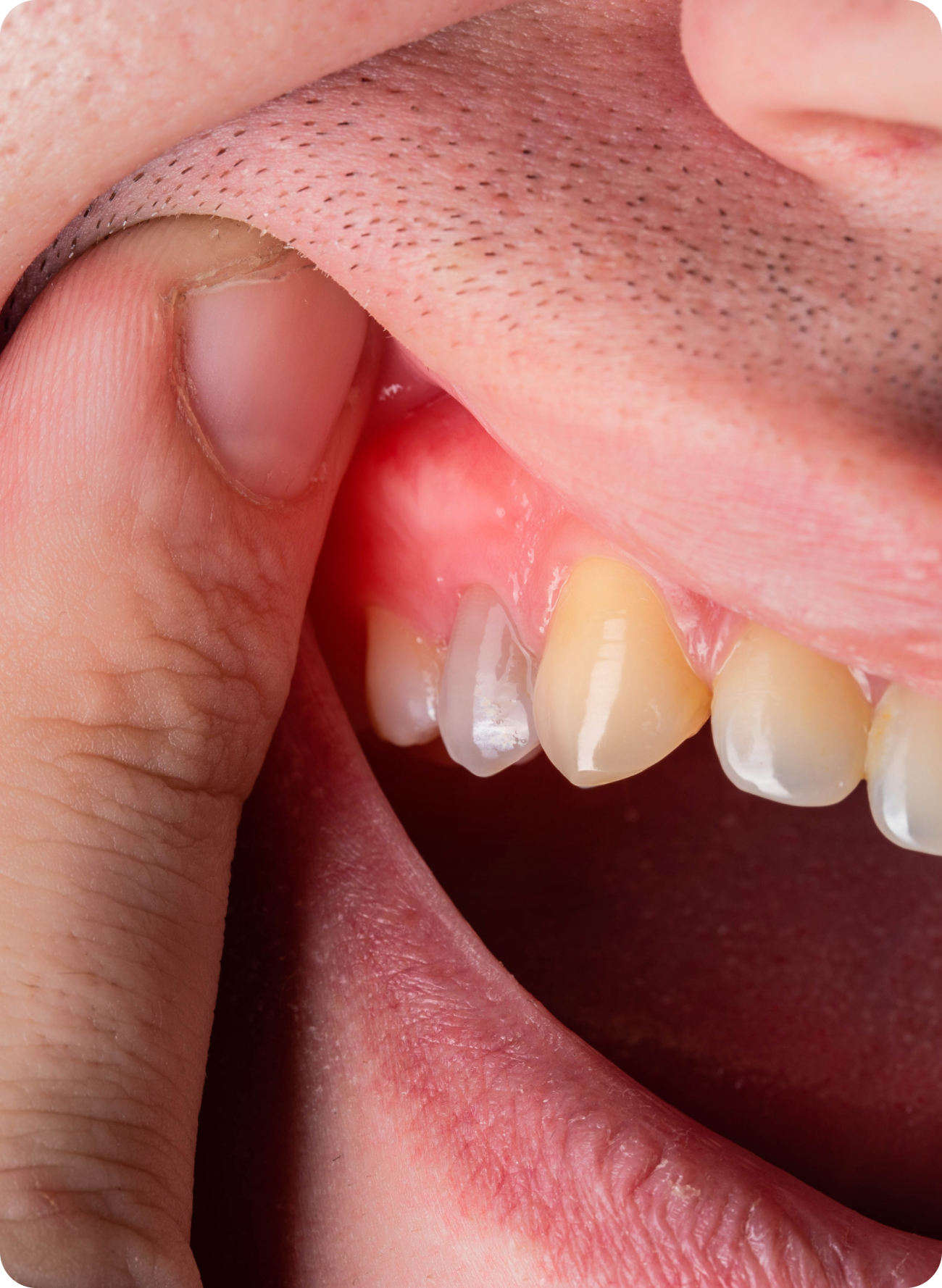
For upper tooth extractions, getting the area numb requires more than one injection. Your provider numbs the tooth itself, but they also place a separate injection directly into the roof of your mouth, an area called the palate. That injection site is often what's hurting.
Why the injection site is often the real culprit
The roof of your mouth has very little cushioning, so injections there can be more noticeable than in other areas. It's common for the injection site to feel bruised or sore for 2–5 days after your procedure.1 This is part of normal healing and usually goes away on its own.
This is especially common after an upper molar or premolar is removed because those teeth usually require a numbing injection in the palate. If you had a lower tooth removed, you probably won't have soreness on the roof of your mouth because that injection isn't needed.
Other reasons the palate can feel tender after surgery
Beyond the injection, a couple of factors can add to the tenderness:
Surgical inflammation
Oral surgery triggers a natural inflammatory response. The palate shares nerve pathways and connective tissue with nearby structures, so some tenderness can radiate there, even if the palate wasn't directly treated.
Bite block pressure
During longer procedures, a small device is often placed in the mouth to keep it open. If it rested against the palate, you may notice mild soreness for a day or two.
Accidental thermal burn
Your mouth stays numb for 1–3 hours after the procedure. If you eat or drink something hot before the numbness fully wears off, you can burn the roof of your mouth without feeling it. The soreness shows up later, once sensation returns.
Gauze contact
If you bit down on gauze after the extraction to control bleeding, that repeated pressure directly contacts the palate and can leave it feeling raw or irritated for a day or two. Neither sensation means something went wrong.
How long will the soreness last?
For most patients, palatal soreness after an upper extraction follows a predictable pattern:
Days 1–2: Feels most tender; may seem bruised or slightly swollen
Days 3–5: Noticeably improving; tenderness starts to fade
Days 5–7: Most patients feel close to normal
Soreness that improves a little each day is a good sign. If your discomfort has plateaued or is getting worse after day 3, it's worth a call to your provider.
Warning signs that need attention
Most cases resolve without any additional care. But contact your provider promptly if you notice any of the following:
Soreness that gets worse after day 3 rather than better
White, gray or yellowish patches appearing on the roof of your mouth
A persistent bad taste or odor that doesn't improve with rinsing
Fever alongside oral soreness
Difficulty swallowing or opening your mouth fully
Discomfort that spreads to your jaw, ear or neck on the same side
Soreness on the roof of your mouth that shows no improvement after 14 days
These can be signs of dry socket — a condition where the protective blood clot over the extraction site is lost or disrupted — or an oral infection that needs prompt evaluation.
What you can do at home
While your palate heals, these steps help ease the tenderness:
Rinse gently with warm salt water (½ teaspoon of salt in 8 oz of water) starting 24 hours after your procedure
Stick to soft foods — yogurt, eggs, mashed potatoes and smoothies — that won't press against the roof of your mouth
Avoid very hot liquids, which can irritate healing tissue
Take over-the-counter ibuprofen or acetaminophen as directed to reduce swelling and soreness
Avoid touching the area with your tongue or fingers, which slows healing
Suck on ice chips (not ice cubes) to temporarily ease palatal tenderness and reduce swelling — especially helpful in the first 24–48 hours
Apply a small amount of OTC benzocaine gel directly to the sore spot if the surface feels irritated — avoid applying anything near the extraction socket itself
Stay away from hard, crunchy or sticky foods for at least the first 5 days of recovery.
When to see your dental provider
If your soreness is improving each day, you likely don't need to come in — your palate is healing as expected. But if discomfort is intensifying rather than fading, or if any of the warning signs above are present, don't wait.
Schedule an appointment at your nearest Aspen Dental office. Getting an early evaluation means any complication — if there is one — can be addressed before it becomes something more serious.
Why is the roof of my mouth sore after a tooth extraction FAQs
If you are experiencing palate discomfort following a dental procedure, it is important to know what is normal and how to manage it. Below are answers to common questions about palate healing.
Can I eat normally while the roof of my mouth is healing?
Not right away. Stick to soft foods for the first 5 days and avoid anything hard, crunchy or very hot. More importantly, wait until the numbness from your procedure has fully worn off before eating or drinking — if your mouth is still numb, you won't be able to feel a burn, and the palate is especially vulnerable to heat in the hours right after surgery.
Can palatal soreness after an extraction be a sign of dry socket?
Dry socket occurs in the extraction socket, not the palate. However, it can cause radiating discomfort that reaches nearby areas including the roof of the mouth. The key difference: dry socket typically causes intense throbbing that begins 1–3 days after extraction and often comes with a bad taste or a visibly empty socket.2 If you notice those specific signs alongside palatal soreness, contact your provider.
What if I had a lower tooth removed — why would the roof of my mouth be sore?
Lower extractions don't require palatal injections, so palatal soreness after a lower extraction is uncommon. It may relate to how your mouth was held open during the procedure or mild tenderness spreading from surrounding tissue. If it doesn't improve within a few days, schedule an evaluation to rule out any other cause.
Should I put anything on the sore spot on the roof of my mouth?
For mild injection-site soreness, no topical treatment is needed — it heals on its own. If the tenderness feels more like a surface irritation than a deep bruised ache, a small amount of OTC benzocaine gel can temporarily ease the discomfort. Avoid applying anything to the extraction socket itself without guidance from your provider.
Sources
1Postanesthetic Ulceration of Palate: A Rare Complication — NIH / PubMed Central: https://pmc.ncbi.nlm.nih.gov/articles/PMC5242082/
2Mayo Clinic. Dry socket — Symptoms and causes. https://www.mayoclinic.org/diseases-conditions/dry-socket/symptoms-causes/syc-20354376