Last updated 05.19.2026
I found a hard lump on my gum — what could it be?
A hard lump on the gum can be caused by a torus, abscess, cyst or gum disease. Learn what the symptoms may mean.

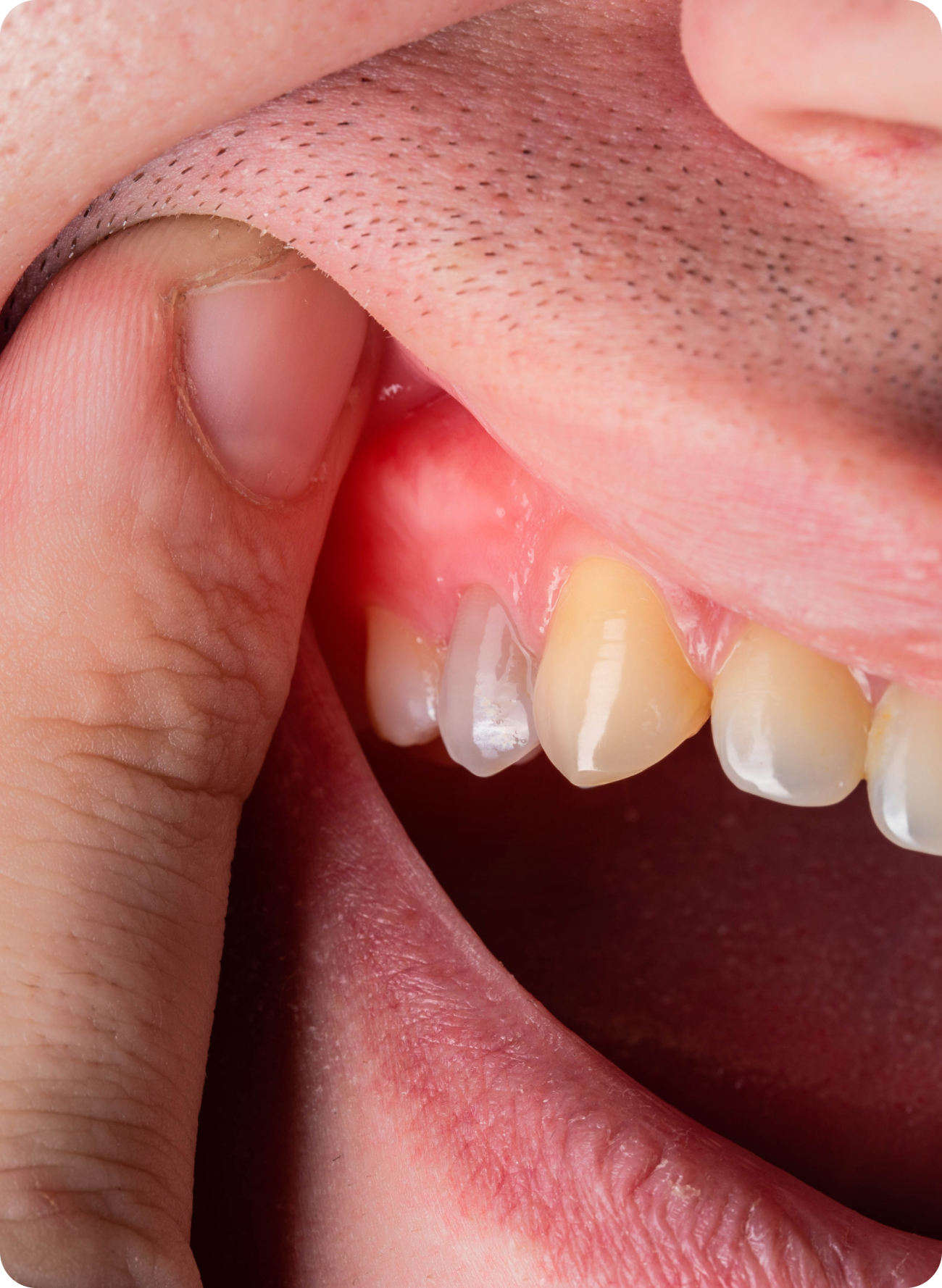
A hard lump on your gum is often harmless, but some lumps can signal an infection or another condition that needs prompt treatment. Hard, painless bumps are commonly caused by benign bony growths. While unpleasant, swollen or growing lumps are more likely to be linked to a dental abscess or another active problem.
In many cases, the location, texture, color and whether the lump hurts can help identify the cause. What you’ll learn in this guide:
The most common causes of hard lumps on the gums
Which lumps are harmless and which may signal infection
Symptoms that should not be ignored
When a gum lump requires urgent evaluation
What your Aspen Dental provider may recommend for treatment
What causes a hard lump on the gum?
Several conditions can cause a lump on the gum. Some are harmless and develop slowly over time, while others are signs of infection or another condition that needs prompt treatment.
Torus (bony exostosis)
A torus is one of the most common causes of a hard, immovable lump on the gum — and one of the most mistaken for something serious. It is a benign overgrowth of normal bone that forms beneath the gum tissue, most often along the inner lower jaw or the roof of the mouth.
Tori are:
Hard and bone-like
Painless
Slow growing
Covered by normal-looking gum tissue
Present for years without changing
They usually do not require treatment unless they interfere with eating, speaking or the fit of a dental appliance. If the lump feels hard as bone and has not changed over time, a torus is one of the most likely explanations — but your Aspen Dental provider should confirm it.
Dental abscess
A dental abscess is a bacterial infection that creates a pocket of pus near the root of a tooth or in the surrounding gum tissue. It is one of the most common causes of a painful gum lump and one of the most urgent to treat.
Signs of a dental abscess include:
A swollen or raised bump on the gum
Throbbing tooth discomfort
Sensitivity to heat or cold
A bad taste or smell in the mouth
Swelling in the face or jaw
Fever or feeling ill
An abscess will not heal on its own. Without treatment, the infection can spread into surrounding teeth, bone, and other areas of the body.3
Treatment depends on the source of the infection and may include:
Root canal therapy
Drainage of the abscess
Antibiotics
Your Aspen Dental provider will determine the appropriate treatment after examining the area and reviewing X-rays.
Oral fibroma
An oral fibroma is a firm, benign overgrowth of connective tissue that forms in response to chronic irritation or minor injury — a rough tooth edge, an ill-fitting denture, or habitual cheek biting are common triggers. Fibromas are usually:
Smooth and dome-shaped
Firm to the touch
The same color as the surrounding gum tissue
Painless
Slow growing
Oral fibromas are considered benign and are not typically associated with cancer.1 If a fibroma becomes irritated or interferes with eating or speaking, your Aspen Dental provider may recommend removing it during a simple in-office procedure.
Gum cyst
A gum cyst is a fluid-filled sac that forms within the gum tissue or near the root of a tooth. Many cysts are painless and may not be noticed until they become large enough to create visible swelling.
Although most cysts are benign, they can place pressure on nearby teeth and bone as they grow. Early evaluation helps prevent damage that may become more difficult to treat later.
Gum cysts do not resolve on their own. They require professional diagnosis — usually confirmed with an X-ray — and treatment ranges from root canal therapy to surgical removal depending on the size and location.
Periodontal (gum) disease
Advanced gum disease can cause the gum tissue to become swollen, thickened and uneven, creating a lump-like appearance around the teeth. In some cases, chronic inflammation can make the tissue feel firm.
Signs of gum disease include:
Bleeding gums
Persistent bad breath
Swollen or tender gums
Loose teeth
If gum disease is causing the lump, treating the underlying infection is necessary to stop further damage to the gums and bone.
Oral cancer
Most lumps on the gum are not cancerous. However, oral cancer can appear as a lump, thickened area, or rough patch on the gum tissue, which is why persistent changes should not be ignored.
Warning signs include:
A lump or sore that does not heal within two weeks
Bleeding without an obvious cause
Numbness in the mouth or jaw
Discomfort when chewing or swallowing
A lump that continues growing
Early detection matters. Oral cancer found at an early stage is far more treatable than cancer discovered after it has spread.2 If you notice any of these warning signs, schedule an evaluation with your Aspen Dental provider promptly.
What the texture tells you
Hard and immovable
A lump that feels hard as bone and does not move is most commonly a torus or bony exostosis. Because the growth is made of bone, it feels identical to the jaw beneath it. These lumps are usually painless, slow-growing, and benign.
Firm with slight movement or “give”
A lump that feels firm but not completely rigid may be a fibroma or a cyst. Fibromas are made of dense fibrous tissue, while cysts contain fluid, which can make them feel softer or slightly compressible in the center.
Soft or fluid-filled
A soft lump that feels like it contains liquid — especially one that is painful or tender — is more consistent with a dental abscess. This type of lump should be evaluated promptly, particularly if it occurs alongside pain, swelling, fever or a bad taste in the mouth.
Rough, irregular, or ulcerated
A lump with an uneven surface, an open sore that does not heal or tissue that bleeds easily should be examined promptly to rule out abnormal tissue changes or oral cancer. Texture alone cannot confirm a diagnosis. Your Aspen Dental provider may examine the area, review your symptoms, and take X-rays or other imaging to determine the exact cause.
What the color tells you
Color is another important clue — and one of the most common reasons patients search for information about gum lumps.
Same color as the surrounding gums
Many benign lumps, including tori, fibromas and some cysts, are covered by normal-looking gum tissue and blend in with the surrounding area. While this is usually reassuring, color alone cannot confirm that a lump is harmless.
White or pale
A white or pale lump can have several causes depending on its appearance and texture.
A white or yellowish bump with a visible “head” is often an abscess close to draining
A flat white patch may be a canker sore or leukoplakia, a thickened area of tissue that sometimes requires further evaluation
A smooth, painless whitish bump is more likely to be a benign cyst or fibroma
Red or dark red
Redness usually signals inflammation or infection. A red, swollen lump that feels tender or warm is more consistent with:
A dental abscess
Active gum disease
Irritated or inflamed tissue
Dark, brown, or black areas
Dark, brown, or black areas most commonly indicate one of three things: a melanotic macule (a benign pigmented spot, the oral equivalent of a freckle), an amalgam tattoo (harmless residue from previous dental work), or in rare cases, a sign worth evaluating promptly. A dark area that is stable, flat, and well-defined is almost never a concern. One that is new, growing, has irregular borders or appears alongside a raised lump warrants professional evaluation.
What discomfort tells you
Discomfort is an important clue, but a painless lump should not automatically be considered harmless.
Lumps that cause discomfort
Lumps that cause discomfort are more commonly linked to infection or active inflammation. A lump that throbs, feels tender when touched or occurs alongside swelling in the face or jaw is more consistent with a dental abscess.
Other warning signs include:
Discomfort that worsens when biting down
Pressure around the tooth or gum
Discomfort that radiates toward the ear or jaw
Fever or a bad taste in the mouth
These symptoms suggest that the infection may be spreading and should be evaluated promptly.
Lumps that don’t cause discomfort
Painless lumps are more likely to be benign conditions such as:
Tori
Fibromas
Gum cysts
However, no discomfort does not always mean harmless. Some cysts, early infections and oral cancers may cause little or no discomfort in the beginning.
A lump that is:
New
Persistent
Growing
Present for more than two weeks
Should still be evaluated by your Aspen Dental provider, even if it does not hurt.
In general:
A hard, painless lump that has been unchanged for years is more consistent with a torus
A soft or smooth painless lump is more consistent with a fibroma or cyst
A clinical exam and, in some cases, X-rays are the only way to confirm the cause.
When to see an Aspen Dental provider
Most gum lumps are benign — but some need attention sooner than others. Use this as your guide.
See an Aspen Dental provider the same day if the lump:
Is throbbing or tender to the touch
Is accompanied by swelling in the face, jaw, or neck
Comes with fever, difficulty swallowing or difficulty opening your mouth
Is draining fluid or pus
These symptoms can indicate an abscess or spreading infection that requires prompt treatment.
Schedule an appointment within the week if the lump:
Has been present for more than two weeks without improving
Bleeds easily or includes an open sore that is not healing
Has grown noticeably over days or weeks
Has changed in size, color, or texture
Monitor and book a routine appointment if the lump:
Is new but completely painless
Has been present for months without being examined
Interferes with eating, speaking or a dental appliance
Most gum lumps are harmless. But abscesses, cysts and abnormal tissue changes will not improve on their own — and the challenge is that serious and benign lumps do not always look different from each other. Discomfort can be a clue, but not every dangerous condition hurts.
A professional evaluation is the only way to know for certain.
If you have found a lump on your gum, do not sit with the uncertainty. An Aspen Dental provider can examine the area and tell you exactly what you are dealing with.
Schedule an appointment today → Same-day and next-day appointments are available at many locations. No referral needed.
Hard lump on my gum FAQs
Can a hard lump on the gum go away on its own?
It depends on the cause. A torus — the most common cause of a hard gum lump — does not go away on its own and does not need to. It is permanent bony growth that is harmless in most cases. An abscess will not resolve without treatment and can worsen if left alone. Fibromas and cysts also do not disappear without intervention. Any lump that persists for more than two weeks should be evaluated.
Is a hard lump on the gum always serious?
No. The most common cause of a hard, immovable lump on the gum is a torus — a benign bony growth that is harmless and requires no treatment in most cases. However, a hard lump that is new, growing, adds discomfort or accompanied by other symptoms should be examined to rule out infection or other causes.
What does a gum abscess lump feel like?
A gum abscess typically feels like a raised, swollen bump that may be firm or slightly soft depending on how much fluid has accumulated. It is usually tender to the touch and may throb. It is often accompanied by a bad taste in the mouth, sensitivity to temperature or swelling in the surrounding area. If you suspect an abscess, see a provider promptly — it will not resolve on its own.
Can a lump on the gum be a sign of oral cancer?
Oral cancer can present as a lump on the gum, but most gum lumps are not cancerous. The key warning signs are a lump that persists beyond two weeks, bleeds easily, causes numbness or is accompanied by difficulty chewing or swallowing. If you notice any of these signs, schedule an evaluation without delay.
What is a whitish lump on the gum?
A whitish lump on the gum can have several causes. A white or yellowish bump with a visible center is often an abscess close to draining. A smooth, pale bump that is painless is more likely to be a fibroma or cyst. A flat white patch — rather than a raised lump — may be a canker sore or leukoplakia, which should be evaluated. Any white growth that persists for more than two weeks warrants a professional assessment.
Will a provider need to do a biopsy?
Not always. Many lumps can be identified through a visual exam and X-rays. A biopsy — where a small tissue sample is taken for lab analysis — is typically only recommended when the cause is unclear or when there is concern about abnormal tissue. Your Aspen Dental provider will let you know if a biopsy is needed after examining the area.
Can I treat a gum lump at home?
Home care cannot treat the underlying cause of most gum lumps. Rinsing with warm salt water may reduce minor irritation or discomfort, but it will not resolve an abscess, cyst, or fibroma. If you are in pain, if the lump is growing or if you have any of the warning signs listed above, do not wait — see a provider.
Sources
1(Cleveland Clinic, Oral Fibroma) https://my.clevelandclinic.org/health/diseases/23991-fibroma
2American Cancer Society, Oral Cancer Survival Rates https://www.cancer.org/cancer/types/oral-cavity-and-oropharyngeal-cancer/detection-diagnosis-staging/survival-rates.html
3 Cleveland Clinic, Tooth Abscess https://my.clevelandclinic.org/health/diseases/10943-tooth-abscess