Last updated 04.30.2026
Leukoplakia: symptoms, causes and treatment
Thick white mouth patches that won't scrape off? Learn about leukoplakia symptoms, causes and treatment.
You may be going through your usual routine, brushing your teeth or looking in the mirror, when you notice something that does not look quite right. Seeing an unfamiliar white patch in your mouth can feel concerning, especially when it does not go away on its own.
What you may be seeing is leukoplakia, a condition that can sound more alarming than it often is. Many cases are benign and linked to an identifiable source of irritation, which means there is often a clear path forward. Getting an accurate diagnosis early is one of the most important steps you can take for your peace of mind and your long-term oral health.
At Aspen Dental, your care team can help evaluate these patches and identify possible causes. With more than 1,100 locations nationwide and same-day appointments often available, care may be closer than you think. By speaking with a dental professional, you can better understand the condition, address the underlying cause and support your oral health.
What is leukoplakia?
Leukoplakia is a condition marked by thick, white or grayish patches that form on the inside of your cheeks, the floor of your mouth or your gums. These patches are different from some other common oral concerns because they are firmly attached to the tissue and cannot simply be brushed or scraped away.
While the name may sound intimidating, understanding what leukoplakia is can help you feel more informed and better prepared to take the next step.
Leukoplakia symptoms
A few key symptoms may point to leukoplakia:
Unusual patches: The most common sign is a white or gray patch in the mouth that does not go away over time. These spots may develop slowly and often do not cause discomfort at first.
Sensitivity to food: Some people notice increased sensitivity to spicy, hot or acidic foods.
Changes in texture: The affected area may feel rough, thickened or leathery compared with the surrounding tissue. This change may be subtle at first but can become more noticeable over time.
Red or mixed-color patches: Some patches may include both red and white areas, a condition known as erythroleukoplakia. These areas may need closer evaluation and should be checked promptly.
If you notice symptoms that last more than two weeks, it is a good idea to schedule a dental visit. Aspen Dental has locations nationwide with flexible hours to help you find a time that works for you.
What does leukoplakia look like?
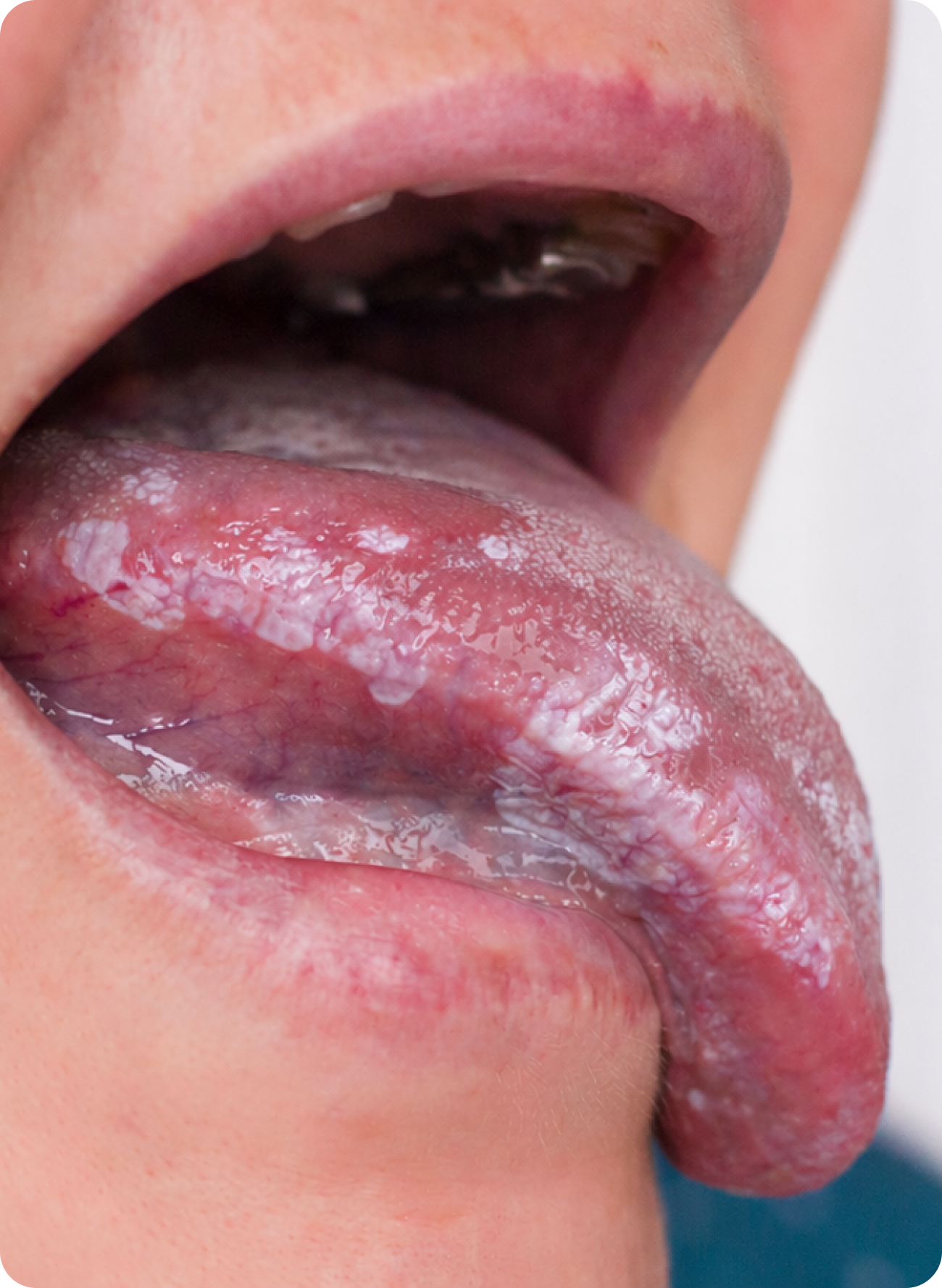
Leukoplakia often appears as white or gray patches on the inside of the cheeks, gums or tongue that do not wipe away.
These areas may look flat or slightly raised and can have a thicker, rough or leathery surface. Some patches may appear smooth, while others may look wrinkled or ridged.
In some cases, you may notice areas with both white and red coloring. If you see changes in the size, shape or appearance of a patch, it is important to have it evaluated.
Hairy leukoplakia
A specific form of this condition, called hairy leukoplakia, has its own distinct appearance and underlying causes. It often appears as white patches with a folded or ridged texture, most commonly on the sides of the tongue rather than the cheeks or gums. The “hairy” look comes from the way the tissue grows in raised, uneven patterns.
According to the Mayo Clinic, hairy leukoplakia is closely associated with the Epstein-Barr virus and is most often seen in people with weakened immune systems.¹
Finding this type of patch may raise broader questions about your overall health and immune function. While its appearance can feel unsettling, it can also provide helpful information for healthcare providers. Your Aspen Dental care team can help recognize the difference and guide you toward the right next step.
Leukoplakia causes
The most common cause of traditional leukoplakia is ongoing irritation to the tissues inside the mouth. This irritation is often linked to tobacco use, whether smoked or chewed, because it exposes the mouth to repeated chemical and physical stress. Heavy alcohol use can also contribute to irritation, especially when combined with tobacco.
Everyday mechanical irritation may also play a role. A sharp or broken tooth, a denture that does not fit well or a habit of biting the inside of your cheek can all lead to changes in the tissue over time.
Identifying the source of irritation is an important part of treatment. Your Aspen Dental provider can help you understand what may be contributing and what steps may help reduce or remove the irritation.
Leukoplakia treatment options
If you notice white patches or oral sores that do not improve within two weeks, it is a good idea to schedule an exam at your local Aspen Dental office. Your treatment journey begins with a comprehensive exam, where your provider will listen to your concerns, review your health history and examine your mouth carefully.
The next step may include diagnosis, which can involve a biopsy to better understand the tissue and confirm what is causing the patch.
Once your provider understands the cause, treatment will focus on removing the source of irritation and, in some cases, removing the patch itself if needed.
Treatment options may include:
Smoothing a rough tooth
Adjusting a denture for a better fit
Providing support and resources for tobacco cessation
Removing affected tissue using a scalpel, laser or freezing technique
Ongoing aftercare, including regular follow-up visits, helps your provider monitor healing and watch for any recurrence.
With care from your Aspen Dental team, you can take clear next steps to support your oral health. Schedule an appointment to get started.
Leukoplakia FAQs
Leukoplakia vs. canker sore — what’s the difference?
A canker sore is usually a painful, shallow ulcer with a red border and a white or yellow center. It often heals within a few weeks. Leukoplakia, on the other hand, appears as a thick white patch that cannot be wiped away and may stay present without treatment.
Leukoplakia vs. thrush — how are they different?
Oral thrush is a fungal infection that often causes creamy white patches that can usually be scraped off, sometimes leaving a red surface underneath. Leukoplakia is different because the patches are more firmly attached and cannot be easily removed.
Is leukoplakia an autoimmune disease?
Leukoplakia itself is not considered an autoimmune disease. It is usually a reactive condition caused by ongoing irritation. Certain forms, such as hairy leukoplakia, are associated with viral infection and are more often seen in people with weakened immune systems.
Leukoplakia self-care — what can I do at home?
Self-care begins with removing possible sources of irritation. That may include reducing or stopping tobacco and limiting alcohol use, along with keeping up a consistent oral hygiene routine. It is important not to scrape or try to treat persistent patches on your own. Instead, schedule a visit with your Aspen Dental provider.
Is leukoplakia cancerous?
Most cases are benign and not cancerous. However, a small percentage of patches may show abnormal cell changes or develop into oral cancer over time. That is why early diagnosis and regular monitoring matter. Your Aspen Dental provider may recommend an oral cancer screening during your exam.
Does leukoplakia go away on its own?
In some cases, a mild patch may improve once the source of irritation is removed. Still, because these patches can sometimes change over time, it is important not to wait without professional guidance.
Is leukoplakia painful?
Traditional leukoplakia is usually not painful, which is one reason it can go unnoticed for a while. Some people may notice mild sensitivity to spicy, hot or acidic foods, but stronger discomfort may suggest another oral health concern that should be evaluated.
Is leukoplakia contagious?
No. Leukoplakia is not contagious. You cannot catch it from another person or pass it through contact, sharing utensils or kissing.
¹Mayo Clinic. Leukoplakia.